Try Beat Watcher on your Apple Watch
Requires Apple Watch Series 3 or newer (watchOS 8+).

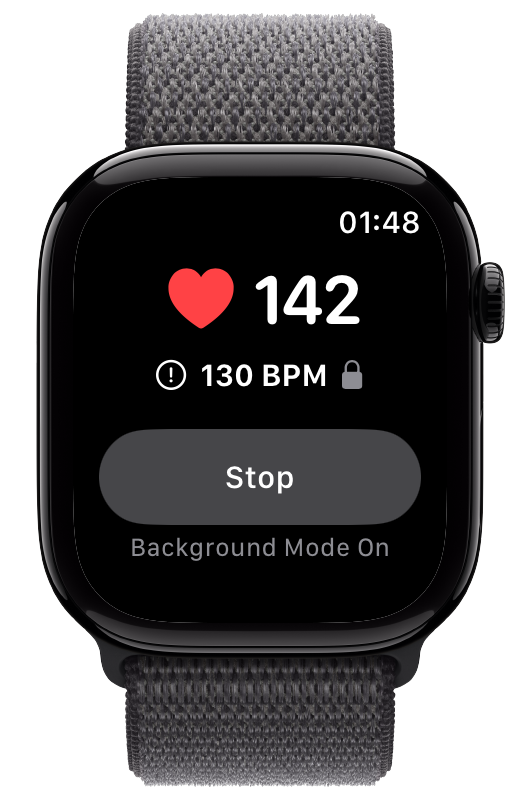
Postural Orthostatic Tachycardia Syndrome causes your heart rate to spike when you stand up. Beat Watcher gives you instant alerts when your heart rate crosses the thresholds you set, so you can pace yourself and manage symptoms in real time.
POTS is a condition where the heart rate increases excessively upon standing. The 2015 Heart Rhythm Society Expert Consensus Statement defines it as a sustained heart rate increase of 30 BPM or more (or above 120 BPM) within 10 minutes of standing, without a significant drop in blood pressure.[1]
POTS affects an estimated 1 to 3 million people in the United States, primarily women between 15 and 50 years of age. Symptoms include dizziness, lightheadedness, fatigue, brain fog, chest pain, and exercise intolerance. There are currently no FDA-approved medications specifically for POTS, making self-management strategies essential.[2]
Because POTS symptoms are driven by heart rate changes, continuous monitoring provides objective data that helps with daily management. A 2025 study published in AMIA Joint Summits on Translational Science Proceedings found that wearable apps with real-time heart rate monitoring can “enhance self-management, improve communication with healthcare providers, and empower patients” to take a more proactive approach to their care.[3]
Knowing your heart rate in real time helps you:
Schedule tasks around your heart rate response. Rest before symptoms become severe.
Learn which activities, foods, or environments cause your heart rate to spike.
Provide objective heart rate patterns to your healthcare provider for better-informed treatment decisions.
Threshold alerts tell you the moment your heart rate crosses a limit, even when you are not looking at your watch.
Beat Watcher is built for exactly this kind of monitoring. Set a heart rate threshold that matches your personal limits, and the app alerts you with haptic vibration and audio the moment your heart rate crosses it.
Unlike checking your heart rate manually, Background Mode continuously monitors your heart rate even when your wrist is lowered or you are using another app. This is critical for POTS patients who need awareness throughout the day, not just when they glance at their wrist.
Set both a high threshold (for tachycardia episodes) and a low threshold simultaneously. This gives you complete coverage of your heart rate range and helps track recovery patterns.
Get notified on your iPhone when thresholds are crossed. Critical Alerts mode cuts through Do Not Disturb for nighttime heart rate monitoring or when your phone is silenced.
When enabled, alerts repeat every few seconds as long as your heart rate remains above your threshold. You will not miss the signal, even if you are focused on something else.
The best heart rate monitor for POTS is the one that tells you what your heart rate is doing the moment it matters, not hours later in a summary. If you are comparing options, these are the features that make the biggest difference for orthostatic intolerance:
POTS heart rate changes happen within seconds to minutes of standing. A monitor that samples only every few minutes can miss the spike entirely. Look for continuous monitoring rather than periodic background checks.
Everyone’s POTS is different. Being able to set your own high and low BPM thresholds, instead of relying on fixed values, lets the monitor match your personal symptom pattern and your doctor’s guidance.
An alert you can feel and hear the instant your heart rate crosses your limit is more useful than a number you have to remember to check. This is what lets you sit down or pace before symptoms escalate.
An Apple Watch you already wear, optionally paired with a Bluetooth chest strap like the Polar H10 for extra accuracy, avoids buying a separate device. A focused app turns that watch into a continuous POTS monitor.
Beat Watcher was built around exactly these criteria: continuous background monitoring, fully customizable high and low thresholds, and instant haptic and audio alerts on Apple Watch, with optional iPhone Critical Alerts. It does not diagnose POTS or any condition and is not a medical device. It gives you real-time awareness of your own heart rate so you can manage your day and share objective data with your provider.
Several Apple Watch apps can alert you when your heart rate crosses a limit, and they take different approaches. Here is an honest comparison of the options people with POTS most often consider.
Set your own high and low BPM thresholds with the Digital Crown and get an instant haptic and audio alert the moment your heart rate crosses either one. Background Mode keeps monitoring when your wrist is down, persistent alerts repeat until you respond, and the optional iPhone companion can send Critical Alerts that cut through Silent Mode and Focus. Free to download. In the U.S. App Store, the optional annual plan costs $12 per year after a one-month free trial. Prices vary by country or region. The iPhone app also includes saved Alert History for reviewing alert events later, adding local notes and context tags, and exporting saved history as a CSV file.
Also built with POTS in mind, and the closest direct alternative to Beat Watcher. It offers customizable upper and lower thresholds and can alert when your heart rate rises or falls a set amount from a recent rolling average. A free tier covers the core alerts, and a premium subscription (around $20 per year) adds CSV and PDF data export plus iPhone-side sensor sessions.
Focused on low heart rate only. It sounds a loud siren if your heart rate drops below a fixed 33 BPM or the signal is lost. There is no high threshold and the low value is not customizable, so it is narrower than a dual-threshold app, but useful if a single fixed low alarm is all you need.
A different job: when your heart rate crosses a high or low limit you set, it can text up to five emergency contacts your name, current heart rate, and a location link. It is built around emergency SOS rather than day-to-day pacing, and its alerts use prepaid SMS credits rather than a subscription.
For pacing POTS day to day, the features that matter most are customizable high and low thresholds, continuous background monitoring, and an alert you feel immediately. Beat Watcher and TachyMon both cover these. Beat Watcher adds persistent alerts, iPhone Critical Alerts, and saved Alert History with local notes, context tags, and CSV export, while TachyMon adds rolling-average alerts, PDF export, and iPhone-side sensor sessions. Beat Watcher is a general wellness app and does not diagnose POTS or any condition.
Requires Apple Watch Series 3 or newer (watchOS 8+).
Apple Watch cannot diagnose POTS, but it can continuously monitor your heart rate. The built-in high and low heart rate notifications on Apple Watch are delayed and only check periodically in the background. A third-party app like Beat Watcher provides instant, customizable threshold alerts with continuous background monitoring, so you know the moment your heart rate crosses your limit. Many POTS patients use this data to track symptom patterns and share objective information with their healthcare providers.
This varies by individual and should be discussed with your doctor. The diagnostic criterion for POTS is a heart rate increase of 30 BPM or more within 10 minutes of standing. Some patients set their threshold at their known resting rate plus 30 BPM, while others set it at the point where they typically begin experiencing symptoms.
Yes. Background Mode keeps monitoring your heart rate even when your wrist is lowered or you switch to another app. You will still receive haptic vibration and audio alerts when your heart rate crosses your threshold.
Yes. Beat Watcher supports both high and low threshold alerts simultaneously. You can set an upper threshold for tachycardia episodes and a lower threshold for bradycardia or to track recovery, giving you complete coverage of your heart rate range.
Yes. The companion iPhone app can forward threshold alerts to your phone. Critical Alerts mode can even cut through Do Not Disturb and Silent Mode, which is useful for nighttime monitoring.
There is no single best monitor for everyone, but the most useful ones for POTS share a few traits: continuous real-time monitoring rather than periodic checks, customizable high and low heart rate thresholds, and immediate haptic and audio alerts when your heart rate crosses a limit. Many people use an Apple Watch they already own with a dedicated alert app like Beat Watcher, optionally paired with a Bluetooth chest strap for added accuracy. Beat Watcher is not a medical device and cannot diagnose POTS; it provides real-time heart rate awareness and objective data you can share with your healthcare provider.
Yes. Beat Watcher and TachyMon are the two main Apple Watch apps built around customizable heart rate threshold alerts, and both are used by people with POTS. Each lets you set your own high and low BPM limits and alerts you the moment your heart rate crosses one. Beat Watcher adds persistent alerts that repeat until you respond, optional iPhone Critical Alerts that cut through Silent Mode, plus saved Alert History with local notes, context tags, and CSV export. It is free to download. In the U.S. App Store, its optional annual plan costs $12 per year after a one-month free trial. Prices vary by country or region. TachyMon adds rolling-average alerts, PDF export, and iPhone-side sensor sessions. The best choice depends on which of those features matters most to you. Beat Watcher is a general wellness app and does not diagnose POTS or any condition.
Yes. Beat Watcher Alert Sharing lets an eligible wearer invite a trusted contact, who can accept and receive high or low threshold alerts in the Beat Watcher iPhone app without purchasing a subscription. Both people can control high and low sharing independently, and either person can disconnect. The paired owner iPhone must remain installed and available. Beat Watcher is a general wellness app, not a medical device, and it does not diagnose POTS or any condition.
Related: Living Alone With POTS · Best Heart Rate Alert Apps · Low Heart Rate Alerts · ME/CFS Heart Rate Pacing · AFib Heart Rate · Pericarditis Heart Rate · Sleep Heart Rate Monitor · Can Apple Watch Alert Someone Else?