Try Beat Watcher on your Apple Watch
Requires Apple Watch Series 3 or newer (watchOS 8+).

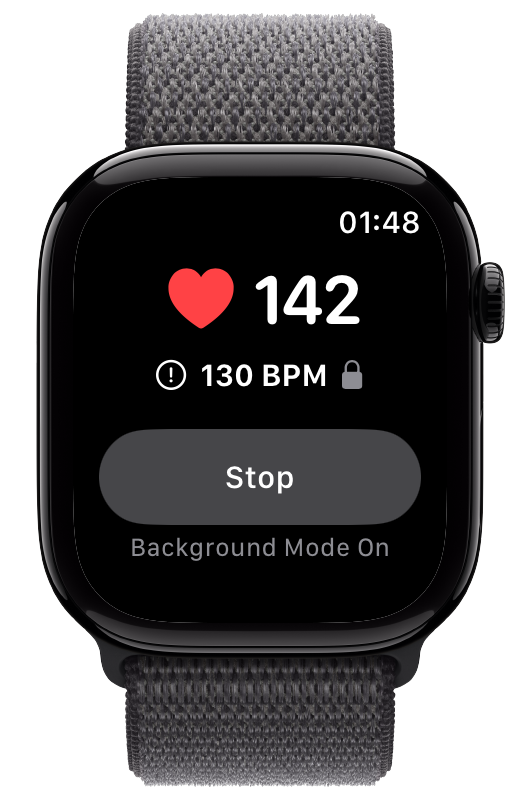
Pacing is a common self-management strategy for ME/CFS and Long COVID. By monitoring your heart rate and staying below a pacing threshold or heart rate ceiling, you can make overexertion more visible. Beat Watcher supports that workflow with instant threshold alerts on Apple Watch.
Myalgic Encephalomyelitis/Chronic Fatigue Syndrome (ME/CFS) is a serious, chronic illness characterized by profound fatigue that is not improved by rest, along with cognitive difficulties, sleep disturbances, and pain. An estimated 3.3 million Americans have ME/CFS, though more than 90% remain undiagnosed.[1]
The hallmark symptom is post-exertional malaise (PEM): a disproportionate worsening of symptoms after physical, cognitive, or emotional exertion. PEM can appear hours after the triggering activity, can last days or longer, and can make it difficult to identify which activities pushed you past your limit without objective data.
Pacing is an energy management strategy where you regulate activity to stay within a sustainable “energy envelope.” It is consistently rated by ME/CFS patients as one of the most helpful management approaches.[2]
The key concept is the anaerobic threshold, sometimes translated into a practical heart rate ceiling. In ME/CFS, research suggests that some people reach anaerobic metabolism at much lower activity levels than healthy controls. Heart rate monitoring gives you a real-time signal when you are approaching the ceiling you chose for pacing.
Two common formulas are used as starting points. Both should be discussed with your healthcare provider:
Formula 1: (220 – your age) × 0.6
Example: Age 40 → (220 – 40) × 0.6 = 108 BPM
Formula 2: Resting heart rate + 15 BPM
Example: Resting HR 65 → 65 + 15 = 80 BPM
Note: Research has shown that age-based formulas do not always predict actual anaerobic thresholds accurately in ME/CFS patients.[3] A two-day cardiopulmonary exercise test (CPET) provides a more individualized measurement but is not widely available and may not be appropriate for everyone.
An international survey of 488 ME/CFS patients found that heart rate monitor use was associated with reduced ME severity and reduced PEM severity and duration. The study documented more than 30 perceived benefits of heart rate monitoring for pacing, with patients reporting better understanding of their limits and improved activity management.[4]
A separate study of the PaceMe app, which uses heart rate-based pacing with wearable alerts, found 89% retention at 8 weeks. Participants described regaining “control of their life” through objective data that validated their experience and helped them identify their personal tipping points for PEM.[5]
The best pacing app depends on the job you want it to do. Some apps focus on symptom diaries, HRV scores, or reports. Beat Watcher is narrower: it turns Apple Watch into a real-time threshold alarm for the heart rate ceiling you choose.
Best fit: people who already use Apple Watch and want immediate haptic, audio, and optional iPhone alerts when their heart rate reaches a chosen BPM limit. Beat Watcher supports Background Mode for continuous monitoring, persistent alerts, low and high thresholds, and Bluetooth chest straps paired to Apple Watch. It includes local Alert History with notes, context tags, and CSV export for saved alert events. It does not provide a full symptom diary, daily energy scores, clinician reports, or treatment advice.
Best fit: people who want illness pacing around daily check-ins, HRV context, symptom tracking, and a broader app experience designed for Long COVID, ME/CFS, POTS, and related conditions. Visible is often cited as a dedicated pacing app, but it is less focused on using your existing Apple Watch as the immediate alert device.
Best fit: people who want a pacing intervention app that combines health signals with subjective check-ins and planning. PaceMe research is promising for Long COVID pacing adherence, but the workflow is broader than simple threshold alerts.
Best fit: people who want structured GO and REST pacing intervals and cues. This is useful if your pacing plan is built around timed activity blocks rather than a simple always-on Apple Watch threshold alert.
Best fit: people who want to review Apple Watch or HealthKit metrics such as heart rate, steps, stand time, and HRV across the day. These tools can help with reflection, while Beat Watcher is focused on in-the-moment alerts when you cross the limit you set.
If your pacing plan is simply “stay below this BPM and alert me when I cross it,” Beat Watcher is intentionally simple. If you want full illness journaling, reports, readiness scores, or coaching, pair Beat Watcher with a dedicated pacing diary instead of expecting one app to do everything.
Use the Digital Crown to set your pacing threshold to the BPM calculated from the formulas above or recommended by your healthcare provider. Beat Watcher alerts you with haptic vibration and audio when your heart rate reaches it.
Background Mode continuously monitors your heart rate even when your wrist is lowered or you leave the app. For pacing, that matters because the activities that push heart rate up are often ordinary ones, like cooking, showering, or walking to the mailbox.
When enabled, alerts repeat every few seconds as long as your heart rate remains above your threshold. That makes the signal harder to miss when you are focused on a task and need a prompt to pause, sit, or rest according to your pacing plan.
For more precise pacing, pair a Bluetooth chest strap (like the Polar H10) with your Apple Watch. Chest straps provide more accurate readings than optical wrist sensors, which matters when your threshold might be as narrow as 80 BPM.
Check your heart rate each morning before getting up. Some pacing plans use resting heart rate changes as context for how hard the previous day was and whether today should be quieter. Beat Watcher is for threshold alerts, so use a diary or Apple Health review alongside it if you want trend tracking.
Long COVID can produce exercise intolerance and post-exertional malaise similar to ME/CFS. Among 465 Long COVID patients studied, 58% met diagnostic criteria for ME/CFS.[6] For people whose clinician recommends heart rate pacing, the practical workflow is similar: choose a heart rate ceiling and use monitoring to notice when you cross it.
A 2023 study found better outcomes among Long COVID patients with high pacing adherence than among those with low adherence.[7] The RHR + 15 BPM rule is one common starting point for a pacing ceiling,[8] but your threshold should reflect your own baseline and medical guidance.
Long COVID has a known trigger, may more often involve shortness of breath or chest pain, and can include cardiac or pulmonary issues that require a different approach than ME/CFS-style pacing. Discuss new or worsening symptoms with your healthcare provider before relying on a heart rate ceiling alone.
Requires Apple Watch Series 3 or newer (watchOS 8+).
Two common formulas are used: (220 minus your age) times 0.6, or your resting heart rate plus 15 BPM. For example, a 40-year-old would calculate (220 – 40) × 0.6 = 108 BPM. These are estimates and should be discussed with your healthcare provider. A two-day cardiopulmonary exercise test (CPET) provides the most accurate measurement.
PEM is a disproportionate worsening of symptoms after physical, cognitive, or emotional exertion. It can appear hours after the triggering activity and can last days or longer. Heart rate monitoring cannot guarantee PEM will not happen, but it can give you a real-time signal when you are approaching or crossing a pacing threshold you chose with your healthcare provider.
Heart rate provides real-time, objective feedback on whether you are approaching a chosen pacing threshold or heart rate ceiling. Without monitoring, some people do not notice overexertion until symptoms worsen later. An international survey of 488 ME/CFS patients found that heart rate monitor use was associated with reduced ME severity and reduced PEM severity and duration.
Yes. Apple Watch provides continuous heart rate monitoring, and a third-party app like Beat Watcher adds customizable threshold alerts with instant haptic and audio feedback. Background Mode means you receive alerts even when your wrist is down, so you do not have to constantly check your watch.
Yes. Beat Watcher works with Bluetooth chest strap monitors like the Polar H10 paired to your Apple Watch. Chest straps provide more accurate readings than optical wrist sensors, which can be important for precise pacing thresholds.
Beat Watcher can be used as an Apple Watch heart rate pacing app when your pacing plan is built around staying below a chosen BPM limit. It is strongest at real-time threshold alerts, Background Mode monitoring, persistent watch feedback, and optional iPhone alerts. It includes local Alert History with notes, context tags, and CSV export for saved alert events, but it is not a full symptom diary, energy-budget score, treatment program, or medical device.
Visible and PaceMe emphasize illness pacing diaries, HRV or readiness-style context, reports, and broader daily planning. Pacing Guard focuses on structured GO and REST pacing intervals. WatchME focuses on Apple Watch and HealthKit pacing metrics. Beat Watcher is narrower: it is for people who already use Apple Watch and want simple, immediate heart rate threshold alerts with optional chest strap support.
Related: POTS Heart Rate Monitor · AFib Heart Rate · Simple Stress Watch