Try Beat Watcher on your Apple Watch
Requires Apple Watch Series 4 or newer (watchOS 9+).

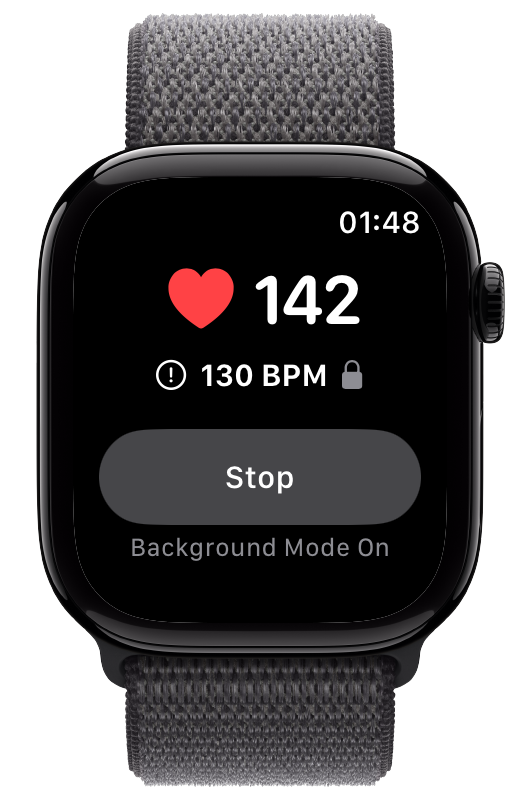
Your heart rate tells a different story while you sleep. Beat Watcher monitors it continuously overnight and alerts you the moment it drops below the threshold you set, even through Do Not Disturb.
Apple Watch records your heart rate overnight on its own, but it samples periodically and surfaces the numbers in the Health app the next morning. To actively monitor your heart rate while you sleep and be alerted in the moment, you need continuous monitoring with a threshold you choose. Here is how to set it up with Beat Watcher:
Open Beat Watcher on your Apple Watch and use the Digital Crown to choose the BPM values that matter to you. For overnight monitoring, many people start with a low threshold a little below their usual sleeping heart rate, and can add a high threshold as well.
Background Mode keeps Beat Watcher monitoring continuously, even with the screen off and your wrist down, so threshold crossings are caught in real time instead of every few minutes.
So an alert can actually reach you while you sleep, turn on Phone Alerts and Critical Alerts. The alert plays a sound on your iPhone even through Sleep Focus and Do Not Disturb. Wear the watch comfortably and keep it charged enough to last the night.
The rest of this guide covers what is normal for a sleeping heart rate, when a low overnight rate is worth watching, and how this differs from Apple Watch’s built-in notification.
Heart rate naturally decreases during sleep. As the body shifts from wakefulness into deeper sleep stages, the parasympathetic nervous system takes over and slows the heart. For most adults, sleeping heart rate settles between 40 and 60 BPM, with the lowest values typically occurring during deep (NREM) sleep.[1]
This overnight dip is normal and healthy. Research on nearly 4,000 patients found that a blunted heart rate dip during sleep (less than 10% decline from daytime values) was independently associated with higher all-cause mortality, suggesting the dip itself is a sign of good cardiovascular health.[2]
The question for many people is not whether their heart rate drops at night, but whether it drops too low.
Bradycardia is the medical term for a heart rate below 60 BPM. During sleep, rates in the 40s and 50s are common and usually benign. A study of healthy adults found that 24% experienced sinus bradycardia below 40 BPM during sleep, with no clinical consequences.[1]
However, context matters. Several situations make overnight heart rate monitoring more relevant:
Beta-blockers, calcium channel blockers, and digoxin are prescribed to lower heart rate. These medications work around the clock, and their effect can be most pronounced during sleep when the body’s natural heart rate is already at its lowest. Monitoring helps you stay aware of how far your heart rate drops overnight.
Obstructive sleep apnea (OSA) frequently causes heart rate to slow during apneic episodes. A meta-analysis of over 4,800 patients found nocturnal bradycardia in approximately 70% of OSA patients, with heart rate drops increasing in severity with longer apnea duration.[3][4]
People with atrial fibrillation, sick sinus syndrome, or heart block may experience significant bradycardia during sleep. For those already managing a heart condition, overnight heart rate data can be valuable context to share with a healthcare provider.
Even without a specific condition, tracking your overnight heart rate over time helps you understand what is normal for you. A sudden change from your baseline, whether higher or lower, can be worth paying attention to.
Use the Digital Crown to set a low threshold anywhere between 30 and 150 BPM. Choose a value that reflects your personal comfort level or your healthcare provider’s guidance. Beat Watcher alerts you with haptic vibration and audio the moment your heart rate drops below it.
Regular notifications are silenced during Sleep Focus and Do Not Disturb. Phone Alerts with Critical Alerts mode bypass this restriction entirely, playing a sound on your iPhone even when your phone is silenced. This is what makes Beat Watcher useful as an overnight monitor: the alert will actually wake you.
Background Mode keeps Beat Watcher monitoring your heart rate even when your wrist is down and the screen is off. Unlike periodic checks that sample every few minutes, Beat Watcher tracks continuously so threshold crossings are caught in real time.
You can set a high threshold alongside your low threshold. This is useful if you want to monitor for both ends: a sleeping heart rate persistently above 100 BPM may indicate conditions like untreated sleep apnea, while a rate that drops unusually low is caught by the low alert.
Alert events you save are kept in Alert History in the iPhone app, including when an alert started, how long it lasted, the threshold at the start, and the starting, ending, and peak or lowest BPM. Add local notes and context tags, and export your saved history as a CSV file.
Apple Watch has a built-in low heart rate notification, and Beat Watcher complements it with more control:
Research has validated that consumer wearable devices, including Apple Watch, provide meaningful heart rate data during sleep, with 86–89% agreement for sleep/wake detection against polysomnography in clinical testing.[5]
Requires Apple Watch Series 4 or newer (watchOS 9+).
For most adults, sleeping heart rate falls between 40 and 60 BPM. Heart rate naturally drops during sleep due to increased parasympathetic nervous system activity. Athletes and physically fit individuals may see rates in the low 40s or even high 30s. What matters most is your personal baseline and whether your sleeping heart rate changes significantly over time.
Yes. With Phone Alerts and Critical Alerts mode enabled, Beat Watcher sends an alert to your iPhone that plays a sound even when Do Not Disturb or Sleep Focus is active. You set the low threshold to a BPM value that matters to you, and Beat Watcher alerts you when your heart rate drops below it.
Beat Watcher uses continuous heart rate monitoring, which does consume more battery than passive overnight tracking. Most users report enough battery to last through the night if the watch starts with a reasonable charge. Pairing a Bluetooth chest strap like the Polar H10 can reduce battery drain since the watch does not need to power its optical sensor.
Apple Watch checks heart rate periodically in the background and can notify you if it detects a rate below a threshold (40, 45, or 50 BPM) after 10 minutes of inactivity. Beat Watcher monitors continuously in real time and alerts you immediately when your heart rate crosses your threshold. You can also set any value between 30 and 150 BPM, and Critical Alerts mode ensures the notification sounds through Do Not Disturb.
Not necessarily. A sleeping heart rate in the 40s is common and usually reflects healthy cardiovascular fitness. However, persistent rates well below your personal baseline, rates accompanied by symptoms like dizziness or extreme fatigue upon waking, or new onset of unusually low readings may be worth discussing with a healthcare provider. Beat Watcher is not a medical device and cannot diagnose any condition.
Wear your Apple Watch to bed and run an app that monitors continuously. Apple Watch’s built-in tracking samples periodically and shows the data the next morning. Beat Watcher monitors in real time: set a low (and optional high) threshold with the Digital Crown, turn on Background Mode, and enable Phone Alerts with Critical Alerts so a sound reaches you through Sleep Focus and Do Not Disturb if your heart rate crosses your limit.
The right app depends on what you need. For passive overnight trends, Apple’s built-in Health tracking is often enough. If you want to be alerted in the moment when your heart rate goes above or below a value you choose, you need continuous monitoring with customizable threshold alerts. Beat Watcher is built for that: any threshold from 30 to 150 BPM, real-time background monitoring, and Critical Alerts that sound through Do Not Disturb. Beat Watcher is not a medical device and cannot diagnose any condition.
Yes. Beat Watcher Alert Sharing lets an eligible wearer invite a trusted contact, who can accept and receive high or low threshold alerts in the Beat Watcher iPhone app without purchasing a subscription. Both people can control high and low sharing independently, and either person can disconnect. The paired owner iPhone must remain installed and available. Beat Watcher is not a medical device and does not diagnose any condition.
Related: POTS Heart Rate Monitor · ME/CFS Heart Rate Pacing · Heart Rate Alerts Guide · Phone Alerts Guide · Background Mode Guide · AFib Heart Rate Monitoring · Can Apple Watch Alert Someone Else? · Simple Stress Watch