Try Beat Watcher on your Apple Watch
Requires Apple Watch Series 4 or newer (watchOS 9+).

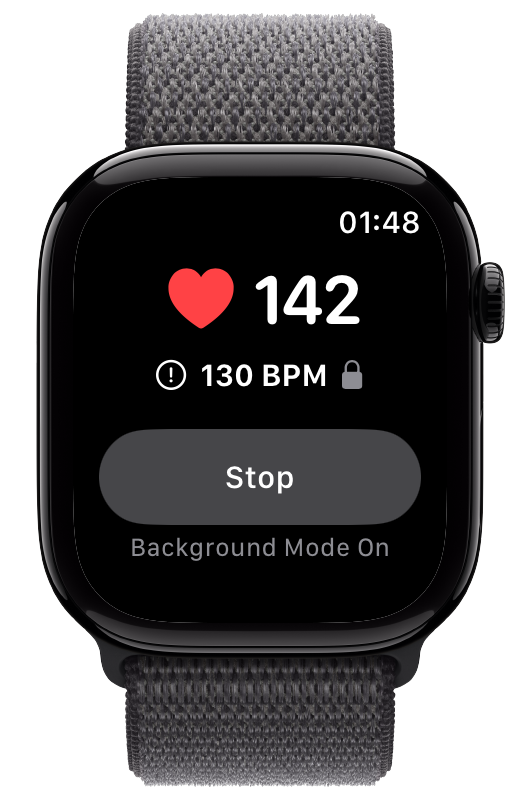
Recovering from pericarditis often means keeping your heart rate below a specific threshold for weeks or months. Beat Watcher provides real-time alerts on your Apple Watch so you know the moment your heart rate rises above the limit your doctor sets.
Beat Watcher tracks your heart rate and alerts you when it crosses a threshold you set. It is not a medical device and does not diagnose or treat pericarditis. Always follow your cardiologist’s guidance on activity levels, medication, and return to exercise. The thresholds mentioned on this page come from published clinical guidelines and are not prescriptions.
Pericarditis is inflammation of the pericardium, the thin sac surrounding the heart. It is the most common inflammatory heart condition, accounting for roughly 5% of emergency room visits for chest pain in Western countries.[1] Symptoms include sharp chest pain that often worsens when lying down or breathing deeply.
Most cases are idiopathic (no identified cause) or presumed viral. Treatment typically involves NSAIDs and colchicine. The landmark ICAP trial showed that colchicine reduced recurrence from 37.5% to 16.7%, but even with optimal treatment, pericarditis recurs in 20–30% of patients after the first episode.[2][5]
Physical activity increases heart rate, and a faster heartbeat increases mechanical stress on the inflamed pericardial layers. Research suggests this can promote ongoing inflammation and extend the course of the disease.[3] Case reports have documented disease progression on cardiac MRI in patients who continued exercising, with regression after they stopped.
The European Society of Cardiology (ESC) guidelines recommend exercise restriction with a maximum heart rate below 100 BPM during physical activity until clinical remission.[1] For athletes, the minimum restriction period is 3 months. If the heart muscle is also involved (myopericarditis), restriction extends to at least 6 months.
Heart rate has also been identified as a predictor of recurrence. A study of pericarditis patients found that heart rate at presentation was one of six independent predictors in a recurrence risk score, with high-risk patients showing nearly 70% recurrence rates compared to 21% for low-risk patients.[4]
Use the Digital Crown to set your threshold to the limit your cardiologist recommends (commonly 100 BPM, sometimes lower). Beat Watcher alerts you with haptic vibration and audio the moment your heart rate crosses it, so you can pause and let it come back down.
During recovery, everyday activities can push your heart rate higher than expected: climbing stairs, carrying groceries, rushing to catch a bus. Background Mode keeps monitoring even when your wrist is down, catching these moments before you realize your heart rate has spiked.
As you recover and your doctor clears you for more activity, you can gradually raise your threshold. Beat Watcher gives you a concrete guardrail at each stage rather than relying on subjective effort levels alone.
Some people use Beat Watcher to track their resting heart rate overnight during recovery. With Phone Alerts and Critical Alerts mode, your iPhone can alert you through Do Not Disturb if your heart rate rises above your threshold while sleeping. See our sleep heart rate monitoring guide for details.
Current guidelines from the ESC and ACC recommend a staged approach to returning to activity after pericarditis:[1][3]
These are general guidelines. Your cardiologist may adjust the timeline and heart rate targets based on your specific situation, imaging, and lab results.
Requires Apple Watch Series 4 or newer (watchOS 9+).
The ESC guidelines recommend keeping heart rate below 100 BPM during physical activity until clinical remission. Your doctor may set a stricter target based on your specific situation. Some clinicians target a resting heart rate below 70 BPM using beta-blockers. Always follow the guidance of your own healthcare provider.
ESC guidelines recommend exercise restriction until symptoms resolve and inflammatory markers (like CRP) normalize. For athletes, the minimum restriction period is 3 months. For non-athletes, the timeline depends on clinical recovery but typically ranges from 1 to 3 months. If myocardial involvement (myopericarditis) is present, restriction extends to at least 6 months.
Beat Watcher lets you set a heart rate threshold on your Apple Watch and alerts you immediately when your heart rate crosses it. During pericarditis recovery, you can set the threshold your doctor recommends (e.g., 100 BPM) and receive haptic and audio feedback the moment you exceed it. This provides real-time awareness so you can adjust your activity level. Beat Watcher is not a medical device and does not replace medical monitoring.
Recurrence affects 20 to 30% of patients after a first episode, even with proper treatment. Among those who experience one recurrence, 25 to 50% will have additional episodes. The ICAP trial showed that adding colchicine to standard treatment reduced recurrence from 37.5% to 16.7%. Heart rate at presentation has been identified as one predictor of recurrence risk.
Some people recovering from pericarditis use Beat Watcher overnight to stay aware of their resting heart rate. With Background Mode and Phone Alerts with Critical Alerts mode, you can receive alerts on your iPhone through Do Not Disturb if your heart rate rises above your threshold during sleep. Discuss with your doctor whether overnight monitoring is appropriate for your situation.
Related: Heart Rate Alerts Guide · Background Mode Guide · Sleep Heart Rate Monitor · AFib Heart Rate Monitoring