Try Beat Watcher on your Apple Watch
Requires Apple Watch Series 3 or newer (watchOS 8+).

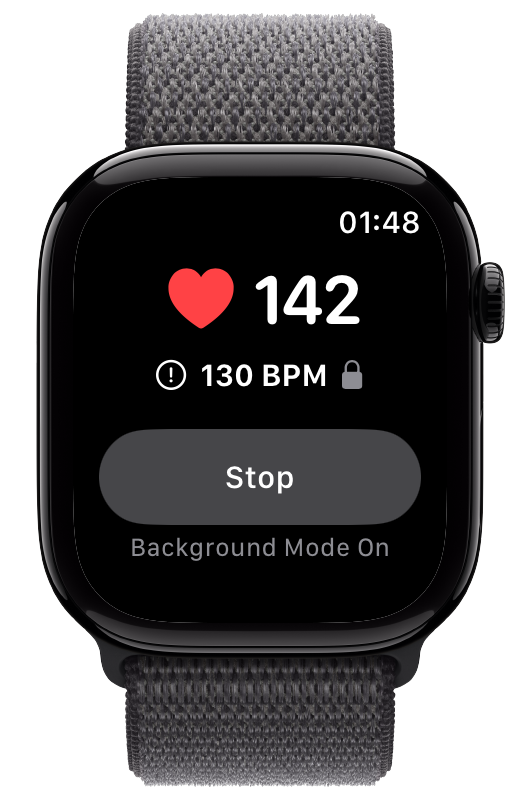
Stress triggers a measurable increase in heart rate. By setting a personal threshold on Apple Watch, you can catch stress responses early and take action before they escalate. Beat Watcher alerts you the moment your heart rate crosses the line.
When your brain perceives a threat, real or imagined, the amygdala sends a distress signal to the hypothalamus. This activates the sympathetic nervous system, releasing adrenaline and norepinephrine. Your heart rate increases, blood pressure rises, and blood is redirected to large muscles. This is the fight-or-flight response.
The problem is that modern stressors (a difficult email, a tense meeting, financial worry) trigger the same cardiovascular response as physical threats. Your heart rate spikes, but there is no physical outlet. Over time, chronic stress with sustained sympathetic activation can damage blood vessels, increase cardiovascular risk, and reduce heart rate variability.[1]
Research shows that simply being aware of your heart rate during stressful moments makes a measurable difference. A 2025 clinical trial compared stress management training with and without real-time heart rate feedback. The version with heart rate biofeedback produced significantly greater stress reduction, while the version without feedback was no better than doing nothing.[2]
A meta-analysis of 24 studies found that heart rate variability biofeedback training produced a large reduction in self-reported stress and anxiety, with consistent effects across different populations.[3]
The takeaway: knowing your heart rate in real time is not just data. It is an intervention. The awareness itself changes your response.
There is no universal “stress heart rate” because everyone’s baseline is different. A more useful approach is to set a threshold based on your personal resting heart rate:
Find your baseline: Check your resting heart rate over several calm days. For most adults, this is between 60 and 80 BPM.
Set your threshold: Add 15 to 25 BPM above your resting baseline. If your resting HR is 68 BPM, a threshold of 85 to 95 BPM would catch most stress-driven elevations without triggering during normal activity like walking.
Adjust over time: Pay attention to which threshold catches real stress moments versus false alarms from movement. Raise or lower it as you learn your patterns.
Set your personal stress threshold and get haptic vibration and audio the moment your heart rate crosses it. This awareness gives you the chance to pause, breathe, and intervene before stress compounds.
Stress often builds during moments when you are not checking your watch: a tense conversation, a stressful commute, a deadline push. Background Mode keeps monitoring and alerts you even when your wrist is down.
Stress can elevate heart rate during sleep. Phone alerts with Critical Alerts mode can notify you on your iPhone even through Do Not Disturb, helping you address nighttime stress responses.
Beat Watcher runs quietly in the background. You only hear from it when your heart rate actually crosses your threshold, so there are no constant notifications adding to your stress.
Anxiety disorders produce the same fight-or-flight response as general stress, but more intensely. During a panic attack, heart rate can spike to 100–150+ BPM as the body reacts to a perceived threat that is not physically present. These episodes typically last 10–30 minutes but feel much longer.
Research reveals a counterintuitive finding: actual heart rate change during stress shows no relationship with how anxious a person feels, but perceived heart rate change is consistently associated with greater anxiety.[4] In other words, anxious people dramatically overestimate how fast their heart is beating. A real-time heart rate monitor provides an objective anchor that directly counteracts this distortion.
Seeing “my heart rate is actually 95, not the 150 it feels like” interrupts the catastrophic misinterpretation that fuels panic spirals. The objective number grounds you in reality.
A randomized controlled trial found that HRV biofeedback increased heart rate variability and reduced panic symptoms in individuals with panic disorder compared to controls.[5]
Note: Heart rate monitoring can increase anxiety in some people by heightening awareness of normal fluctuations. The goal is calibration and reassurance, not hypervigilance. If monitoring your heart rate makes you more anxious, discuss this with your healthcare provider.
Requires Apple Watch Series 3 or newer (watchOS 8+).
Yes. When you perceive a threat or stressor, your brain activates the sympathetic nervous system, releasing adrenaline. This increases your heart rate, blood pressure, and cardiac output as part of the fight-or-flight response.
There is no universal stress heart rate number because individual baselines vary. A resting heart rate persistently elevated 10 to 15 BPM above your personal baseline is a more meaningful indicator than any fixed number. Beat Watcher lets you set a personalized threshold based on your own normal range.
Apple Watch tracks heart rate and heart rate variability (HRV), both of which reflect autonomic nervous system activity related to stress. While it does not label moments as “stressed,” a third-party app like Beat Watcher can alert you when your heart rate exceeds a threshold you associate with stress.
Yes. A meta-analysis of 24 studies found that heart rate variability biofeedback produced a large reduction in self-reported stress and anxiety (effect size 0.81). A separate clinical trial showed that stress management with real-time heart rate feedback was significantly more effective than the same intervention without feedback.
Related: POTS Heart Rate Monitor · ME/CFS Pacing · Sauna Heart Rate