Try Beat Watcher on your Apple Watch
Requires Apple Watch Series 3 or newer (watchOS 8+).

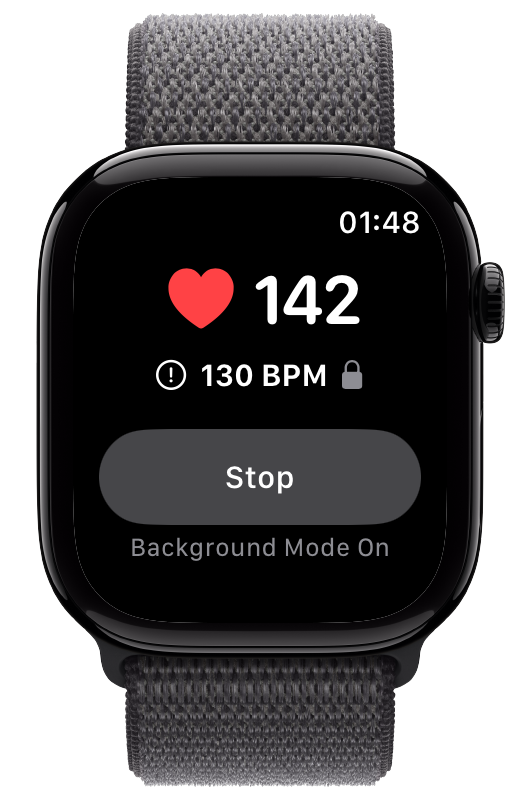
Most people set a timer for their sauna sessions. A better approach: set a heart rate threshold and let your body tell you when it has had enough. Research shows sauna bathing elevates heart rate to levels equivalent to moderate exercise, and the cardiovascular benefits are real.
A 2019 study in Complementary Therapies in Medicine found that the heart rate and blood pressure response during sauna bathing corresponds to submaximal dynamic exercise at 60 to 100 watts, comparable to moderate cycling.[1] Heart rate rises continuously throughout the session, typically reaching 120 to 150 BPM.[2]
Cardiac output increases 60 to 70% as your body pumps blood to the skin for cooling. This is genuine cardiovascular stress, just driven by heat instead of muscular work.
The landmark Kuopio Ischaemic Heart Disease study followed 2,315 Finnish men for over 20 years. The findings were striking:[3]
4 to 7 sauna sessions per week was associated with a 50% lower risk of fatal cardiovascular disease compared to 1 session per week.
Frequent sauna users had a 63% lower risk of sudden cardiac death compared to those who used the sauna once per week.
Sessions longer than 19 minutes showed a 52% lower risk of sudden cardiac death compared to sessions under 11 minutes.
After sauna, resting heart rate drops below baseline (from 77 to 68 BPM in one study) and heart rate variability shifts toward parasympathetic dominance.[4]
Time-based sauna protocols (like “stay for 20 minutes”) do not account for individual variation. Your cardiovascular response to heat depends on your fitness level, hydration, sleep quality, whether you exercised beforehand, and the sauna temperature and humidity.
A heart rate-based approach adapts automatically. A well-conditioned person might stay 25 minutes before reaching their threshold. Someone less fit or slightly dehydrated might reach it in 12 minutes. Both get an appropriate cardiovascular stimulus without overstaying.
For a healthy adult, 140 BPM is a reasonable exit threshold. This falls within the observed physiological range (120 to 150 BPM) and corresponds to roughly 70 to 78% of maximum heart rate for someone in their 30s to 40s.
Adjust for your situation:
Higher fitness level: could raise to 150 BPM
Age over 60: consider 120 to 130 BPM
Post-exercise sauna: lower your threshold since HR is already elevated
On heart rate-lowering medication: HR-based approach may not be appropriate; consult your doctor
Set Beat Watcher to your target BPM (e.g., 140) before stepping into the sauna. When your heart rate reaches that level, you will feel a haptic tap and hear an audio alert telling you it is time to exit.
Turn on Background Mode so the alert works even if you are not looking at your watch. You can close your eyes, relax, and trust that Beat Watcher will tell you when to get out.
With Persistent Alerts enabled, the haptic and audio feedback repeats every few seconds as long as your heart rate stays above threshold. In a hot, relaxing environment, this makes sure you do not miss the signal.
If you prefer not to wear your Apple Watch in the sauna, pair a Bluetooth chest strap (like the Polar H10) with your Apple Watch kept outside. The chest strap sends heart rate data to the watch, which triggers the alert.
Regardless of your heart rate, exit the sauna immediately if you feel dizzy, lightheaded, nauseous, or confused, or if you experience chest pain or palpitations. Cool down gradually. Avoid alcohol before or during sauna use. Stay hydrated.
Requires Apple Watch Series 3 or newer (watchOS 8+).
Research shows heart rate typically rises to 120 to 150 BPM during a sauna session, with average heart rates around 100 to 105 BPM and peak rates reaching 140 to 145 BPM. This corresponds to low-to-moderate intensity exercise.
For a healthy adult, 140 BPM is a reasonable exit threshold. It falls within the normal physiological range observed in sauna research (120 to 150 BPM) and corresponds to approximately 70 to 78% of maximum heart rate. A more fit person will take longer to reach 140 BPM, automatically adjusting session length to individual cardiovascular capacity.
Yes. A landmark Finnish study of 2,315 men found that 4 to 7 sauna sessions per week was associated with a 50% lower risk of fatal cardiovascular disease and a 63% lower risk of sudden cardiac death compared to 1 session per week. Sessions longer than 19 minutes showed stronger benefits.
Apple does not recommend exposing Apple Watch to saunas due to high temperatures. Many people do use them in saunas at their own risk. An alternative is to pair a Bluetooth chest strap (like the Polar H10) with your Apple Watch worn outside the sauna, or to keep the session brief. Check Apple’s guidance for your specific model.
Leave immediately if you feel dizzy, lightheaded, nauseous, or confused, or if you experience chest pain or heart palpitations. Cool down gradually after exiting. Avoid alcohol before or during sauna use, and stay well hydrated.
Related: Stress Heart Rate Monitor · POTS Heart Rate Monitor