Try Beat Watcher on your Apple Watch
Requires Apple Watch Series 3 or newer (watchOS 8+).

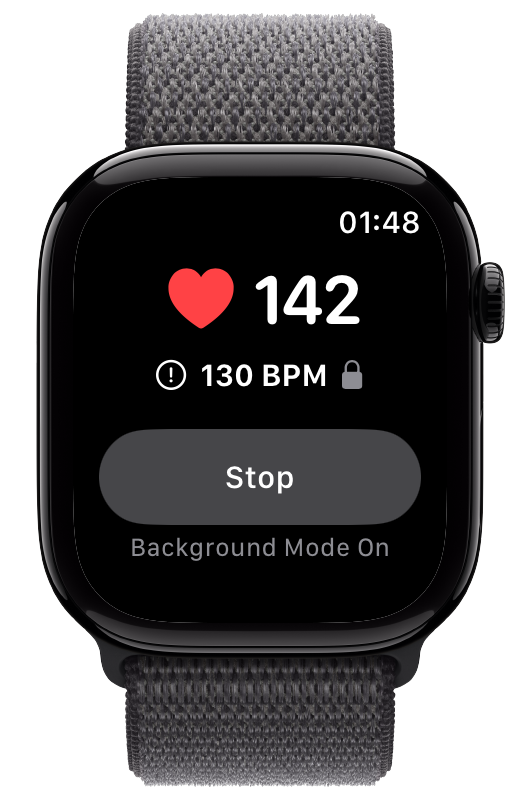
Postural Orthostatic Tachycardia Syndrome causes your heart rate to spike when you stand up. Beat Watcher gives you instant alerts when your heart rate crosses the thresholds you set, so you can pace yourself and manage symptoms in real time.
POTS is a condition where the heart rate increases excessively upon standing. The 2015 Heart Rhythm Society Expert Consensus Statement defines it as a sustained heart rate increase of 30 BPM or more (or above 120 BPM) within 10 minutes of standing, without a significant drop in blood pressure.[1]
POTS affects an estimated 1 to 3 million people in the United States, primarily women between 15 and 50 years of age. Symptoms include dizziness, lightheadedness, fatigue, brain fog, chest pain, and exercise intolerance. There are currently no FDA-approved medications specifically for POTS, making self-management strategies essential.[2]
Because POTS symptoms are driven by heart rate changes, continuous monitoring provides objective data that helps with daily management. A 2025 study published in AMIA Joint Summits on Translational Science Proceedings found that wearable apps with real-time heart rate monitoring can “enhance self-management, improve communication with healthcare providers, and empower patients” to take a more proactive approach to their care.[3]
Knowing your heart rate in real time helps you:
Schedule tasks around your heart rate response. Rest before symptoms become severe.
Learn which activities, foods, or environments cause your heart rate to spike.
Provide objective heart rate patterns to your healthcare provider for better-informed treatment decisions.
Threshold alerts tell you the moment your heart rate crosses a limit, even when you are not looking at your watch.
Beat Watcher is built for exactly this kind of monitoring. Set a heart rate threshold that matches your personal limits, and the app alerts you with haptic vibration and audio the moment your heart rate crosses it.
Unlike checking your heart rate manually, Background Mode continuously monitors your heart rate even when your wrist is lowered or you are using another app. This is critical for POTS patients who need awareness throughout the day, not just when they glance at their wrist.
Set both a high threshold (for tachycardia episodes) and a low threshold simultaneously. This gives you complete coverage of your heart rate range and helps track recovery patterns.
Get notified on your iPhone when thresholds are crossed. Critical Alerts mode cuts through Do Not Disturb for nighttime monitoring or when your phone is silenced.
When enabled, alerts repeat every few seconds as long as your heart rate remains above your threshold. You will not miss the signal, even if you are focused on something else.
Requires Apple Watch Series 3 or newer (watchOS 8+).
Apple Watch cannot diagnose POTS, but it can continuously monitor your heart rate. The built-in high and low heart rate notifications on Apple Watch are delayed and only check periodically in the background. A third-party app like Beat Watcher provides instant, customizable threshold alerts with continuous background monitoring, so you know the moment your heart rate crosses your limit. Many POTS patients use this data to track symptom patterns and share objective information with their healthcare providers.
This varies by individual and should be discussed with your doctor. The diagnostic criterion for POTS is a heart rate increase of 30 BPM or more within 10 minutes of standing. Some patients set their threshold at their known resting rate plus 30 BPM, while others set it at the point where they typically begin experiencing symptoms.
Yes. Background Mode keeps monitoring your heart rate even when your wrist is lowered or you switch to another app. You will still receive haptic vibration and audio alerts when your heart rate crosses your threshold.
Yes. Beat Watcher supports both high and low threshold alerts simultaneously. You can set an upper threshold for tachycardia episodes and a lower threshold for bradycardia or to track recovery, giving you complete coverage of your heart rate range.
Yes. The companion iPhone app can forward threshold alerts to your phone. Critical Alerts mode can even cut through Do Not Disturb and Silent Mode, which is useful for nighttime monitoring.
Related: ME/CFS Heart Rate Pacing · AFib Heart Rate