Try Beat Watcher on your Apple Watch
Requires Apple Watch Series 3 or newer (watchOS 8+).

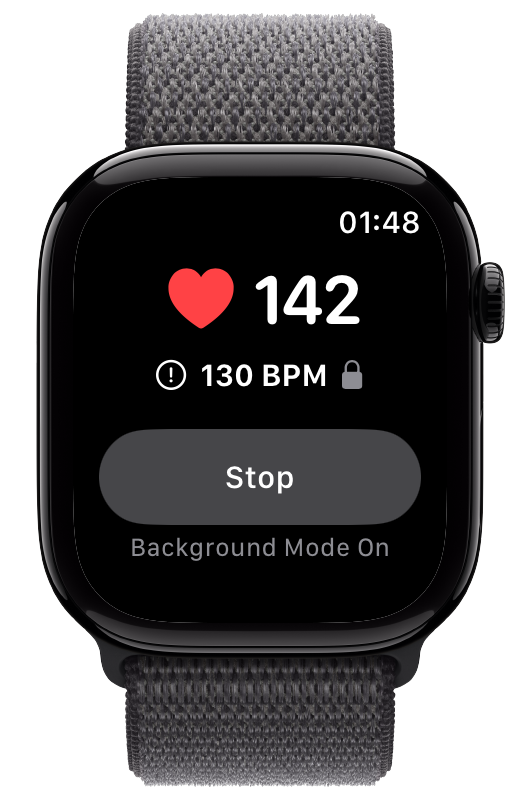
For the estimated 10 million Americans living with atrial fibrillation, keeping heart rate within a target range is a daily concern. Beat Watcher provides instant threshold alerts on Apple Watch so you know the moment your heart rate drifts outside the range your doctor recommends.
Beat Watcher monitors your heart rate (beats per minute) and alerts you when it crosses a threshold. It does not detect atrial fibrillation rhythm. Apple Watch has separate built-in features for AFib rhythm detection (Irregular Rhythm Notification, ECG app). Beat Watcher complements these by providing real-time rate-control alerts.
Atrial fibrillation (AFib) is the most common clinically significant cardiac arrhythmia, characterized by rapid, irregular electrical activity in the heart’s upper chambers. This causes an irregular and often rapid heart rate, commonly 120 to 160+ BPM during episodes. AFib affects approximately 1 in 22 American adults and increases stroke risk by about 5 times.[1]
The primary treatment approach for many AFib patients is rate control: using medications (beta-blockers, calcium channel blockers, or digoxin) to keep the heart rate within a target range. Monitoring whether this target is being met is where heart rate threshold alerts become valuable.
Your doctor will set a heart rate target based on your symptoms and condition. Two common approaches:
Recommended for patients with symptoms like palpitations, shortness of breath, or fatigue. Requires closer monitoring and sometimes multiple medications.
Supported by the RACE-II trial for patients without significant symptoms. Easier to achieve, fewer medications, and no increased risk of cardiovascular events compared to strict control.[2]
The ORBIT-AF registry of 2,812 AFib patients found that both excessively high and excessively low resting heart rates were associated with higher mortality, with the lowest risk at approximately 65 BPM. This suggests that monitoring for both high and low thresholds matters.[3]
Use the Digital Crown to set your threshold to the target your doctor prescribes (e.g., 110 BPM for lenient control). Beat Watcher alerts you with haptic vibration and audio the moment your heart rate exceeds it.
Rate-control medications can cause heart rate to drop too low. Set a low threshold (e.g., 55 or 60 BPM) to catch bradycardia, which is associated with increased mortality in AFib patients.
Background Mode keeps monitoring even when your wrist is down, you are sleeping, or you are using another app. AFib episodes can occur at any time, and you will know immediately when your rate exceeds your target.
Research has shown that wrist-worn devices can underestimate heart rate during AFib, especially at higher rates.[4] Beat Watcher supports Bluetooth chest straps like the Polar H10 for more accurate readings when precise rate-control monitoring matters.
Apple Watch has built-in features for AFib management, and Beat Watcher complements them:
A 2024 study in Nature Medicine found that consumer wearable data predicted functional status in AFib patients comparably to traditional clinical measures, supporting their use as monitoring tools.[5]
Requires Apple Watch Series 3 or newer (watchOS 8+).
No. Beat Watcher monitors heart rate (beats per minute), not heart rhythm. It cannot detect whether your heart is in atrial fibrillation or normal sinus rhythm. Apple Watch has a separate built-in feature for irregular rhythm detection. Beat Watcher complements this by alerting you when your heart rate exceeds a threshold, which is useful for rate-control management.
This depends on your rate-control strategy as directed by your doctor. Common targets are below 80 BPM at rest (strict control) or below 110 BPM at rest (lenient control). You might also set a low threshold to catch bradycardia from rate-control medications.
Research has shown that wrist-worn devices can underestimate heart rate during AFib, especially at higher rates (by up to 48 BPM at 120–140 BPM). For more accurate monitoring, Beat Watcher supports Bluetooth chest strap heart rate monitors like the Polar H10, which provide more reliable readings.
Apple Watch’s irregular rhythm notification and ECG app analyze heart rhythm to detect whether you are in AFib. Beat Watcher monitors your heart rate number and alerts you when it crosses a threshold you set. Apple Watch tells you if you are in AFib; Beat Watcher tells you when your heart rate is too high or too low, which matters for ongoing rate-control management.
Related: POTS Heart Rate Monitor · Heart Rate Alerts Guide · Background Mode Guide