Try Beat Watcher on your Apple Watch
Requires Apple Watch Series 3 or newer (watchOS 8+).

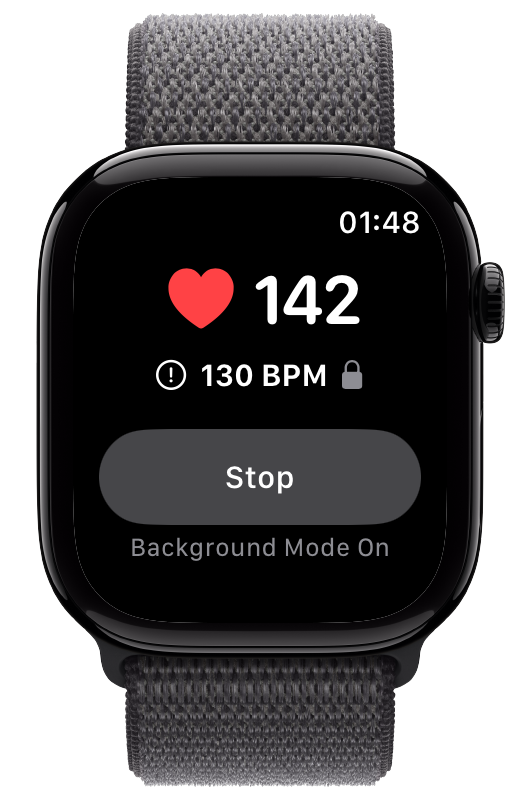
Zone 2 training builds your aerobic engine, improves fat burning, and forms the foundation of endurance fitness. The challenge is staying in the zone. Beat Watcher taps you the moment you drift too high, so you can train by heart rate without constantly watching your wrist.
Zone 2 is low-to-moderate intensity exercise performed just below your first lactate threshold. At this intensity, your body relies primarily on fat for fuel, blood lactate stays near resting levels, and you can sustain the effort for long periods. You should be able to hold a conversation, though breathing is noticeable.[1]
Elite endurance athletes across all disciplines spend approximately 75–80% of their training volume at this intensity. Research shows this “polarized” approach (high volume at low intensity + small amounts of high intensity) produces the greatest improvements in well-trained athletes.[2]
The Karvonen formula gives the most personalized estimate because it accounts for your resting heart rate:
Step 1: Max HR = 220 – your age
Step 2: Heart Rate Reserve (HRR) = Max HR – Resting HR
Step 3: Zone 2 lower = (HRR × 0.60) + Resting HR
Step 4: Zone 2 upper = (HRR × 0.70) + Resting HR
Example (age 35, resting HR 60): HRR = 185 – 60 = 125.
Zone 2 = (125 × 0.60) + 60 to (125 × 0.70) + 60 = 135–148 BPM
If you do not know your resting heart rate: Zone 2 = 60–70% of (220 – age).
Example (age 35): 60–70% of 185 = 111–130 BPM
This is less precise because it does not account for fitness level. The Karvonen method is preferred.
For the most accurate Zone 2 range, a lab-based lactate threshold test measures your actual first lactate threshold. This is the gold standard but requires a sports medicine facility.
The biggest challenge with Zone 2 training is that it feels too easy, and most people instinctively go too hard. Without real-time heart rate feedback, you naturally drift into Zone 3, sometimes called the “gray zone.” This intensity is too hard to recover from quickly and too easy for high-intensity adaptations.
Even at a constant pace, heart rate naturally rises over time due to dehydration and heat. A pace that starts in Zone 2 can drift into Zone 3 after 20–30 minutes without you noticing.
Hills, wind, heat, and humidity all push heart rate up independently of pace. Pace-based training cannot account for these. Heart rate adapts in real time.
Use the Digital Crown to set your threshold to the top of your Zone 2 range (e.g., 148 BPM from the Karvonen example). The moment your heart rate drifts above it, you get a haptic tap and audio alert. Slow down, heart rate drops, and you are back in the productive zone.
Zone 2 workouts are often 45–90 minutes. Background Mode keeps monitoring even when your wrist is lowered, so you do not have to keep glancing at your watch during long runs, rides, or walks.
As cardiac drift pushes your heart rate up over a long session, the alert catches it before you have spent 10 minutes in Zone 3 without realizing. No mental math, no constant watch-checking.
After weeks of getting tapped back down, you develop a feel for true Zone 2 effort. The alerts become less frequent as you internalize the correct intensity.
Research shows that fat oxidation and blood lactate are strongly inversely correlated (r = –0.92 to –0.98). At Zone 2 intensity, where lactate stays low, your body burns fat most efficiently. This metabolic flexibility is strongly associated with mitochondrial function and overall metabolic health.[1]
A 2025 review noted that higher intensities can produce comparable mitochondrial adaptations in less time, but Zone 2 training remains valuable because it can be performed in high volume with minimal fatigue, recovery cost, and injury risk. It forms the backbone of a program that includes some high-intensity work.[3]
Requires Apple Watch Series 3 or newer (watchOS 8+).
Zone 2 is typically 60–70% of your maximum heart rate using the simple formula, or 60–70% of your heart rate reserve using the Karvonen formula. For a 35-year-old with a resting heart rate of 60, the Karvonen method gives a Zone 2 range of approximately 135–148 BPM.
That is the point. Zone 2 is below your first lactate threshold, where your body efficiently uses fat for fuel. It should feel conversational. Most people instinctively train too hard, drifting into Zone 3 where they are too tired to recover quickly but not working hard enough for high-intensity adaptations.
Zone 2 workouts are typically 30 to 90 minutes. The benefit comes from sustained time at this intensity. Elite endurance athletes spend 75–80% of their total training volume at low intensity.
Yes. Set your threshold to the top of your Zone 2 range. Beat Watcher will tap you with haptic feedback the moment your heart rate drifts above it. Background Mode keeps monitoring even when your wrist is down, so you do not have to keep checking your watch during long sessions.
Related: Sauna Heart Rate · Pregnancy Heart Rate · Heart Rate Alerts Guide