Try Beat Watcher on your Apple Watch
Requires Apple Watch Series 3 or newer (watchOS 8+).

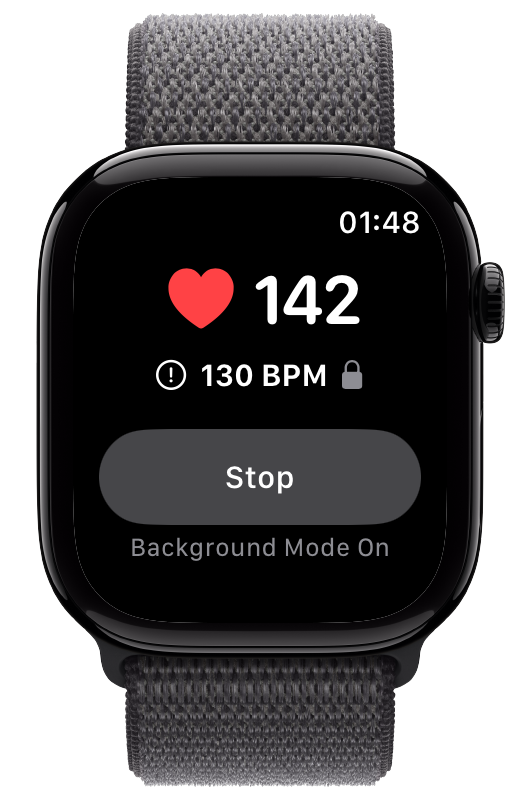
Exercise during pregnancy is recommended by ACOG and supported by research. But your cardiovascular system changes significantly during pregnancy, making subjective intensity assessment unreliable. Heart rate monitoring gives you an objective measure to exercise confidently within safe limits.
Pregnancy produces major cardiovascular adaptations to support the developing baby. Resting heart rate increases by 10–20 BPM, cardiac output rises 40–50% above pre-pregnancy levels, and blood volume expands by approximately 50%.[1] These changes mean a workout that felt comfortable before pregnancy may push into higher relative intensity at the same pace.
ACOG notes that “blunted and normal heart-rate responses to exercise have been reported in pregnant women,” meaning some women’s hearts respond less to exercise than expected, while others respond normally. Without objective monitoring, you cannot know which category you fall into on any given day.[2]
The old “stay below 140 BPM” rule was removed by ACOG in 1994 due to insufficient evidence. Current evidence-based guidance comes from the 2019 Canadian guideline, which provides age-specific target zones for moderate-intensity exercise during pregnancy:[3]
| Age | Target HR Zone | Set Threshold To |
|---|---|---|
| Under 20 | 140–155 BPM | 155 BPM |
| 20–29 | 135–150 BPM | 150 BPM |
| 30–39 | 130–145 BPM | 145 BPM |
| 40+ | 125–140 BPM | 140 BPM |
Start at the lower end of your range, especially when beginning a new program or later in pregnancy. Always discuss exercise plans with your healthcare provider.
Research suggests using perceived exertion alone is unreliable during pregnancy. A 2024 review in BMJ Open found that half of the studies examined showed no correlation between perceived exertion and actual heart rate during pregnancy.[4] The expert consensus recommends using both heart rate monitoring and perceived exertion together.[5]
Your resting heart rate climbs 10–20 BPM over the course of pregnancy. A workout that was comfortable at 16 weeks may push into higher relative intensity at 32 weeks at the same pace.
Heart rate gives you a number that tracks your changing cardiovascular baseline in a way that subjective “how hard does this feel” cannot.
Use the Digital Crown to set your threshold to the top of your age-specific zone from the table above. Beat Watcher taps you the moment you exceed it.
Lower your threshold as you move into the second and third trimesters. The Canadian guideline recommends working at the lower end of your range later in pregnancy.
Background Mode monitors continuously through your workout. No need to keep checking your wrist. If you exceed your limit, you will feel the tap.
Stop immediately and contact your healthcare provider if you experience:
Requires Apple Watch Series 3 or newer (watchOS 8+).
No. ACOG removed the 140 BPM heart rate cap in 1994 due to insufficient evidence. Current guidelines recommend using perceived exertion and heart rate monitoring together, with age-specific target zones rather than a single universal cap.
The 2019 Canadian guideline provides age-specific zones: under 20 years, stay below 155 BPM; ages 20–29, below 150 BPM; ages 30–39, below 145 BPM; ages 40+, below 140 BPM. These are for moderate-intensity exercise. Always discuss with your healthcare provider.
Pregnancy changes your cardiovascular system in ways that affect how exercise feels. Resting heart rate increases 10–20 BPM, blood volume expands by 50%, and vascular resistance drops. These changes make subjective intensity assessment inconsistent. Research shows that half of studies found no correlation between perceived exertion and actual heart rate during pregnancy.
Stop immediately and contact your healthcare provider if you experience vaginal bleeding, feeling dizzy or faint, shortness of breath before starting exercise, chest pain, headache, muscle weakness, calf pain or swelling, regular painful contractions, or fluid leaking from the vagina.
Related: Zone 2 Training · Heart Rate Alerts Guide